Basajaun
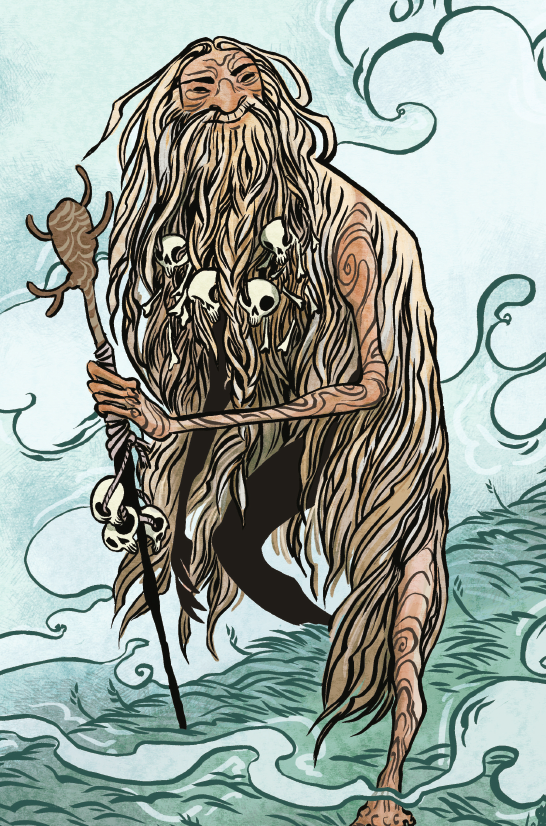
Grandfather of the Farmers, Big Hairy Grandad
People


Locations


Folklore

Chapters


Scientific Inquiry and Journaling
by Prof Dr Gary
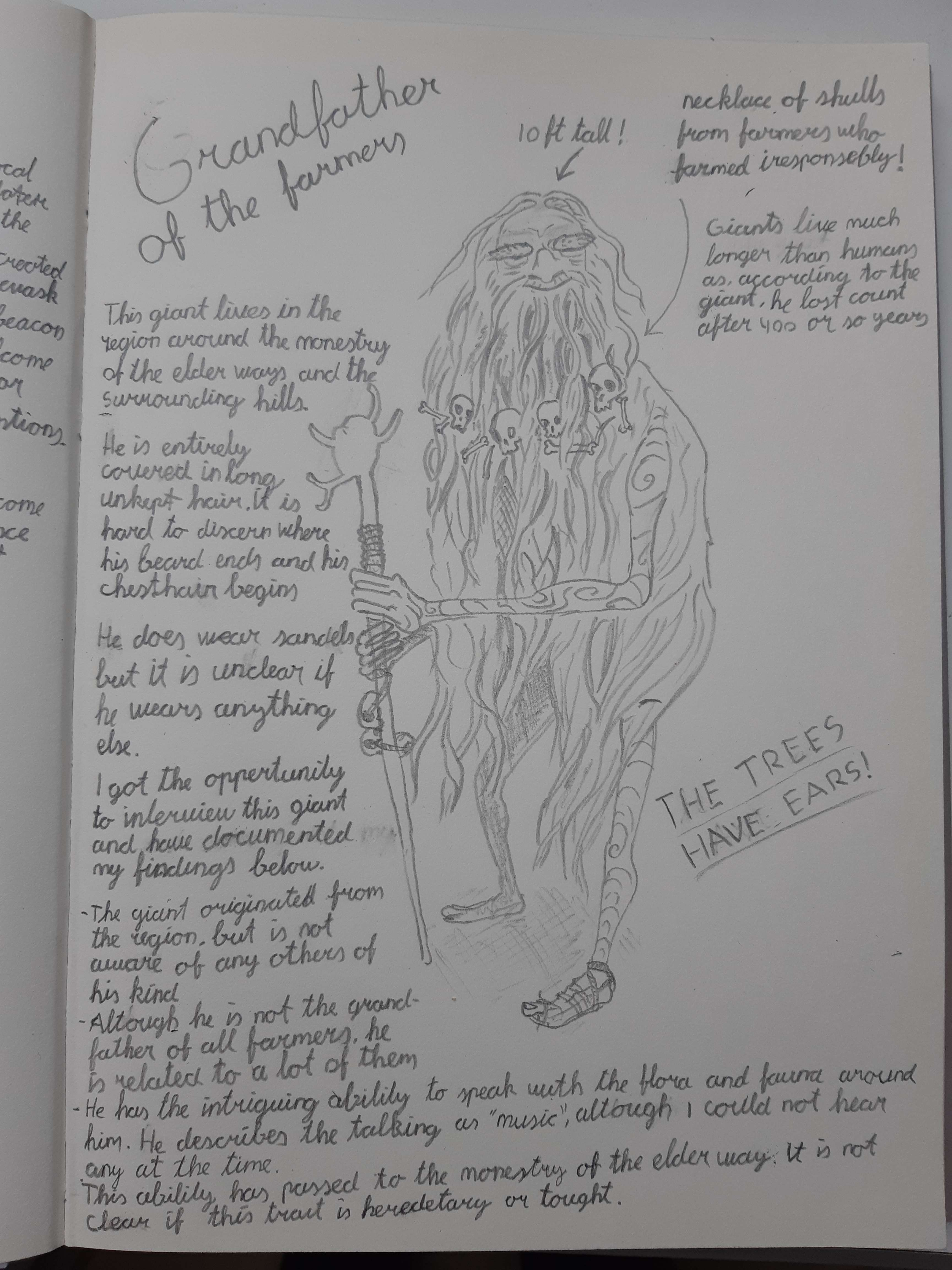
1: what the skulls on his necklace are from From the villagers in the Northern mountains (between Fort Duhrin and the Druid Monastery), who were producing too much.
2: Is he actually related to all farmers/ the monastery of the elder way? Not to all the farmers. But the right ones in Wyrmbark. He fathers children from selected brides from the villages. The Monastery takes some of his children when needed.
3: how old he is (do giants live longer) Hundreds of years old.
4: where he is from From here. His kin has always lived south of the Old One.
5: If there are more of his kind Not that he knows.
6: how he speaks to the animals /plants? By speaking their tong. He has taught the Druids and the Witch of Nevask how to do so too.
7: and what are the animals/plants talking about. That humans just take too much.
8: How do animals/plants talk (like do they have large vocabulary or not)? They are able to communicate simple concepts. Not with phrases like people do. It is more like music.
3m giant, from the legends of the Hairy Druids of the Big Ford.
- Loves tricks and laughter—may lure you to a cliff just for the joy of it.
- It will protect sheep and shepherds, chasing off wolves or warning of avalanches.
- Breaks into cabins, eats your stew, drinks your wine, and takes your clothes—if you stay still.
- Kidnaps human brides, treats them tenderly, mourns his dead children, and guards his domain with fury.
- Senses intruders instantly—his knowledge of his land is uncanny and complete.
- His body may give rise to oak trees, suggesting he returns to the earth in death.
- Violent yet protective, joyful yet tragic, he is a force of nature with fur and mind.
- Cursed a mountain village northwest of the Big Ford for producing beyond their needs.
Mid-winter crisis, 1026
In the old stories of Gravenmark there are beings older than kingdoms. Among them is the Basajaun.
A great forest giant from the northeastern hills of Wyrmbark, the Basajaun knows the lands better than any human. He understands the winds, the rivers, the turning of the soil, and the quiet rhythms by which fields grow fertile.
Long ago, it was the Basajaun who taught humans how to farm these lands. The first ploughs, the cycles of sowing and harvest, and the care of grain were once secrets of the giant folk.
In time, that knowledge passed fully into human hands. And the Basajaun withdrew to the hills and forests.
But the story did not end there.
Generations ago, the Basajaun’s daughters walked among humans. Some loved, some were taken, and some simply vanished into the settlements of men. Their descendants now live scattered across the people of Gravenmark, their blood diluted but not lost.
The Basajaun has returned. He walks the land once more, searching for the blood of his kin hidden among humans.
Yet he also sees a deeper disorder spreading across the region. Famine grows. The land is misused. Knowledge of the soil is twisted, forgotten, or trapped in books rather than lived through the land itself.
Goal
Your goals are twofold: Restore the proper tending of the land and find the descendants of your daughters.
Pressures
Sigisfarne: The village farms the land using knowledge once taught by the Basajaun. Among its people may live descendants of your daughters.
The Piot Chants: The molefolk seek to reclaim farmland for the earth beneath it, threatening the balance between land, forest, and settlement.
The Monks of Middle-Waters: The monastery preserves farming knowledge in books and manuscripts. To the Basajaun, such knowledge belongs to the living land, not to ink and parchment.
The Fae of the Queensweald: The Fae seek to mix their blood with humans, spreading changelings and goblin offspring among the villages. This risks further confusing the bloodlines you are trying to trace.
The Druids of Wyrmbark: The druids claim deep knowledge of the old forest and its powers. It is possible that some of your distant descendants have been taken in or hidden among them.