Sigisfarne
Grassland Village
Migrant families - a group of three families arrived in Sigisfarne in Nov-Acorn. They fled their familial villages in the north after cultists came and started killing their people. You hear that amongst them, at least 10 people were killed.
People
 Arlo
Arlo  Aspen
Aspen  Ayrrin
  Cai
Cai  General Cobb
  Daegal
  Drake Flint Gerrik Hilda
  Kalamos
  Mateus
  Moun Cacalou
  Oswin
Oswin  Pebble Razzy Rabbit
  Rushd Ibn Ubada
  Stone Tarmac Vihero
  Yewtree
  Lord Griffin
  Subvicar Jock
Factions
Locations
 Queensweald
  Rabbit's Inn
  Middle Waters
  Ambaret
  Mountain Court
  Deverain
  Gravenmark
  Underground Temple
  Duskmeadow Fringe
Folklore


Chapters
 March 1
  March 6
  March 10
  March 19
  April 9
  April 27
  May 7 May 17
  July 7
  August 11
  September 18
  September 28
  November 3
  November 8
  November 27
  February 20
  March 24
  April 10
  May 25
  June 28
  July 15
  July 24
  October 29
Founding forgotten by living memory and ancient farmland clinging to the edge of the old forest.
A hundred crooked buildings lean against each other, their timbers groaning with age. The paths between them sink deep.
Built on, around and in the ruins of a past civilisation, with ancient architectural modes different from what we use in the village now. Talented artifices put together these structures.
Relations
Sigisfarne used to be a direct vassal of the crown in Ambaret.
Multiple crop failures in the years leading the year of 1025. This was impacted in March.
Due to failing crop production, the crown has handed it over the a new liege lord: the Mountain Court. Lord Griffin from the court, has appointed Jock as the village subvicar. Sigisfarne sends a portion of the produce from the farms to Deverain via riverboat.
Religion
As with the rest of the Kingdom, all people from Sigisfarne are devoted to the Church of the Weeping Mother. The local priest is young and not confident
Mid-winter crisis, 1026
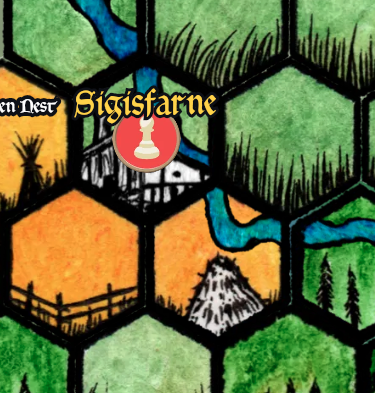
Sigisfarne is an old frontier village standing at the edge of the forest and the grasslands of northern Gravenmark.
A hundred crooked houses lean against one another along muddy paths, their timbers groaning with age. The village is ancient even by local standards, built upon the ruins of an older civilisation, with strange stone structures and foundations whose builders are long forgotten.
For generations, the people of Sigisfarne lived by farming these lands. The fields were once renowned for their productivity, carefully engineered long ago to produce abundant harvests.
But the last few years have been cruel.
Crop failures have struck repeatedly, and the village has recently been placed under the authority of the Mountain Court, which still demands tribute despite the failing harvests.
Now the land itself has turned against its farmers.
Much of the farmland has been claimed by Piot Chant nests, networks of tunnels dug beneath the soil by strange mole-like folk who prey upon crops that encroach too far toward the forest.
Fields collapse without warning. Livestock vanish into burrows. Reclaiming the land means war beneath the earth.
Winter has now settled over the region.
Food stores are dangerously low, while refugees from the northwest continue to arrive in ragged groups seeking shelter after violence and strange killings in their own villages.
Yet Sigisfarne still possesses one advantage: its people.
The village holds farmers, hunters, woodcutters and labourers hardened by life on the frontier. If organised and led, they could reclaim land, forage the woods, defend the settlement, or attempt a desperate migration south.
If they lose hope, the village will collapse before spring.
Goal
Your goal is simple: Survive the winter.
Pressures
The Piot Chant Nests: Large areas of farmland are lost to underground colonies. Any attempt to reclaim fields will provoke conflict.
Famine and Refugees: Food stores are nearly depleted, while displaced families continue to arrive in search of shelter.
Lord Griffin’s Rule: Sigisfarne now answers to the Mountain Court, which still expects tribute and obedience.
The Fae of Queensweald: The fae see famine and refugees as an opportunity. Goblins and changelings spread through hardship, and many among the fae would welcome mixed bloodlines among the desperate people of Sigisfarne.
The Basajaun: The ancient giant of the hills seeks the descendants of his long-lost daughters, now scattered among human bloodlines. If he comes to claim them, the village may not be able to refuse.